Bridging the emissions gap
Ireland has set ambitious climate targets aimed at reducing greenhouse gas emissions by at least 42% by 2030 under the EU’s Effort Sharing Regulation. This target forms part of a broader national commitment to decarbonise the economy, with particular focus on increasing renewable energy generation, improving energy efficiency, and reducing emissions across various sectors. However, recent projections from the Environmental Protection Agency (EPA) indicate that Ireland is on course to fall substantially short of these targets, achieving only up to a 29% reduction by 2030 unless additional measures are implemented. This concerning gap highlights the critical importance of robust environmental monitoring systems in tracking progress, identifying shortfalls, and informing effective policy interventions.
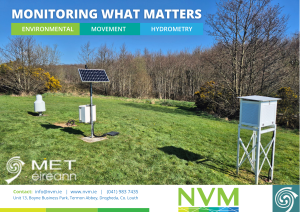
The team at NVM are experienced in a wide range of environmental monitoring, which involves the systematic collection of data related to environmental conditions, including air and water quality, soil health, and weather patterns. The evolution of Internet of Things (IoT) technology has significantly enhanced monitoring capabilities by deploying networks of connected sensors that continuously gather data from various sources. These advanced systems allow for real-time tracking of environmental parameters and provide the foundation for meaningful climate action.
In Ireland, the Environmental Protection Agency leads environmental reporting efforts, collecting and analysing greenhouse gas emissions data, monitoring various environmental indicators, and providing comprehensive reports to both the government and the public. This information is essential for assessing Ireland’s progress towards meeting its climate targets, particularly those set under the Climate Action and Low Carbon Development Act (Amendment) 2021 and the EU Effort Sharing Regulation. The Climate Action and Low Carbon Development (Amendment) Act 2021 established a legally binding framework for Ireland’s transition to a climate-neutral economy by 2050. Among its provisions, the Act requires a 51% reduction in greenhouse gas emissions by 2030 compared to 2018 levels and mandates the adoption of five-year carbon budgets starting in 2021. These carbon budgets represent the total amount of greenhouse gases that can be emitted nationally during each five-year period, with the current programme consisting of three budgets: 295 MtCO2eq for 2021-2025, 200 MtCO2eq for 2026-2030, and a provisional 151 MtCO2eq for 2031-2035.
To achieve these targets, Ireland has established specific sectoral emissions ceilings that set maximum limits for greenhouse gas emissions in different economic sectors. For the 2021-2025 budget period, these include 40 MtCO2eq for electricity, 54 MtCO2eq for transport, and 106 MtCO2eq for agriculture, among others. Energy-related emissions account for almost all emissions in the electricity, transport, residential, and commercial sectors, and around two-thirds of emissions in the industry sector.
Environmental monitoring has an increasingly large and important role to play in supporting Ireland’s climate goals:
(i) Firstly, it enables accurate data collection and analysis, providing the empirical foundation for climate policy development and implementation. The deployment of advanced monitoring technologies, such as those offered by companies like NVM Limited, allows for precise measurement of environmental parameters and emissions levels.
(ii) Secondly, environmental monitoring facilitates effective tracking and reporting of progress towards climate targets. By continuously monitoring emissions and other environmental indicators, authorities can identify areas of success and concern, enabling timely interventions where necessary. This is particularly important given the EPA’s projection that Ireland will miss its 2030 targets by a substantial margin unless additional measures are implemented.
(iii) Thirdly, environmental monitoring helps assess the impacts of climate change on various aspects of the environment, such as air and water quality, biodiversity, and ecosystems. This information is crucial for developing effective adaptation strategies and for identifying vulnerable areas that require particular attention.
(iv) Finally, environmental monitoring supports sustainable development by tracking progress towards Ireland’s sustainability goals and providing data for identifying areas where further action is needed. This information informs policy decisions, promotes sustainable practices, and encourages public engagement in environmental protection efforts.
The growing NVM team provide vibration and noise monitoring instrumentation, embankment monitoring equipment, geotechnical instrumentation, and environmental data monitoring services and have supported local authorities, universities, and construction companies in meeting their environmental obligations. Products such as the AVA Trace system for vibration measurement, the Svan971 sound level meter, and the DM30 Dustsens air quality monitor represent the forefront of environmental monitoring technology.
As Ireland strives to meet its 2030 climate goals, the role of environmental monitoring will become even more important. The gap between current projections and target emissions reductions demonstrates the need for enhanced monitoring capabilities, more robust data analysis, and more effective policy interventions. By leveraging advanced monitoring technologies and data-driven approaches, Ireland can better track its progress, identify areas requiring urgent attention, and implement targeted measures to bridge the emissions gap.
For project-specific advice, please contact us on info@nvm.inview.ie