Behind This Week’s Heatwave Forecast: The Monitoring Network That Makes It Possible
Met Éireann has issued a nationwide weather advisory for a prolonged spell of very warm or hot weather, running from Wednesday into early next week. Temperatures are expected to widely exceed 25°C, potentially reaching the high 20s or low 30s from Friday, with high to very high UV levels and the possibility of tropical nights over the weekend.
For built-environment professionals, advisories like this carry practical weight: heat stress on site, drought pressure on water resources, elevated wildfire risk, and thermal effects on infrastructure and materials. But behind every forecast, advisory and heatwave declaration sits something less visible — a national network of monitoring stations producing the ground-truth data that makes the forecast possible.
How a heatwave is actually measured
In Ireland, a heatwave is defined as five or more consecutive days with maximum temperatures above 25°C at a given station. That definition only works if the station data is accurate, continuous and trusted. A drifting temperature sensor or a gap in transmission doesn’t just affect one reading – it can compromise a dataset relied upon for national forecasting, climate records and public safety advisories.
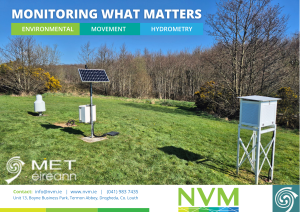
Met Éireann’s Climate Automated Monitoring Programme (CAMP) network – typically 60 to 80 stations distributed across the country — provides this ground-level data. Each station carries a suite of specialist instruments: air temperature and humidity sensors, soil sensors, grass temperature sensors, rain gauges and rainfall counters. Together they deliver continuous, site-specific climate data back to Met Éireann for analysis, modelling and forecasting.
NVM’s role in the network
NVM holds the service, maintenance and supply contract for Met Éireann’s CAMP stations nationwide. Our work covers routine and reactive maintenance, on-site calibration, sensor replacement and servicing, data logger and power system upkeep, data acquisition and management, and verification that live data is transmitting successfully to Met Éireann.
During a heatwave, this work matters more, not less. Sustained high temperatures are precisely the conditions under which sensor accuracy is scrutinised – these are the readings that determine whether heatwave thresholds are met, feed drought assessments, and inform advisories on heat stress and wildfire risk. Preventative maintenance, early fault detection and rapid response keep the network delivering when the data is under the most demand.
The wider picture: heat, drought and water resources
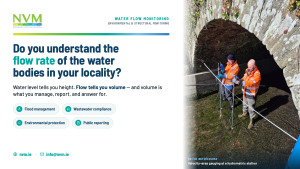
Prolonged warm, dry spells don’t just register on thermometers. They draw down river flows and groundwater levels, concentrate pressure on abstraction points, and raise drought concerns – all of which Met Éireann has flagged as potential impacts of the current spell. Hydrometric and groundwater monitoring becomes central to how local authorities, Uisce Éireann and the EPA assess and manage water resources through the summer months.
NVM supports this side of the picture too, through hydrometric flow monitoring, groundwater instrumentation, and weather and solar monitoring for clients across the public and private sectors. Whether it’s a national climate network or a single low-flow gauging point, the principle is the same: decisions are only as good as the data behind them.
If you have an environmental monitoring requirement – climate, hydrometric, groundwater or weather station infrastructure – get in touch with the NVM team.
📧 info@nvm.inview.ie | 📞 (041) 983 7435 | www.nvm.inview.ie