The Role of Environmental Monitoring in Achieving Ireland’s 2030 Climate Goals
While often criticised at home, Ireland’s 2030 climate target is among the most ambitious in Europe.
Under the Climate Action and Low Carbon Development (Amendment) Act 2021, the State is legally bound to reduce greenhouse gas emissions by 51% by 2030, relative to 2018 levels, and to reach climate neutrality by 2050. The Climate Action Plan 2025 reaffirms that target and sets revised sectoral pathways across electricity, transport, the built environment, industry, agriculture and land use.
The gap between policy ambition and projected outcome is well documented. The EPA’s most recent greenhouse gas projections, published in May 2025, indicate that, even with full implementation of currently planned measures, Ireland is on track for a reduction of up to 23% by 2030. The first carbon budget (2021–2025, 295 MtCO₂eq) is projected to be exceeded by 8 to 12 MtCO₂eq, and the second budget (2026–2030, 200 MtCO₂eq) by a significantly larger margin once carryover is included. Ireland’s separate target of a 42% reduction under the EU Effort Sharing Regulation is also out of reach on the current trajectory.
These projections are derived from monitored data. Carbon budgets, sectoral emissions ceilings and adaptation planning are only as credible as the measurement infrastructure that underpins them. Without continuous, verified environmental data, neither progress nor underperformance can be properly assessed, and corrective policy cannot be evidence-based.
This is where environmental monitoring moves from a compliance activity to a strategic function. Meeting 2030 targets requires a substantial scaling of renewable electricity, including thousands of megawatts of additional onshore wind and solar capacity, alongside offshore wind and a continued role for hydropower. Each of these technologies depends on accurate environmental data – water levels and flow for hydro feasibility and operation, weather data for siting and yield, and ground conditions for foundation design and asset protection.
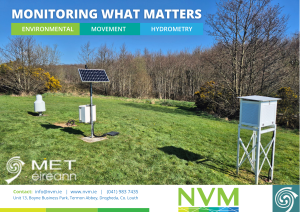
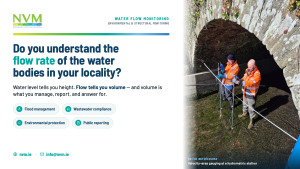
For hydropower and water-dependent infrastructure, hydrometric monitoring of river flows, levels and rainfall remains foundational. NVM Limited supplies and maintains OTT Hydromet hydrometric sensors and data loggers, including instrumentation deployed in support of Met Éireann’s national observation network. The same categories of data feed flood forecasting, abstraction assessment and the analysis of climate-driven changes to Ireland’s hydrological cycle.
For wind, solar and grid-scale developments, the construction and operational phases each carry distinct monitoring obligations. Vibration, noise and dust monitoring protect sensitive receptors during civil works and demonstrate compliance with planning conditions, EPA licence requirements and conditions imposed by An Coimisiún Pleanála. Geotechnical instrumentation – piezometers, inclinometers, settlement points and tilt sensors – provides early warning of ground movement on substations, turbine foundations, cable routes and battery storage compounds.
The same monitoring disciplines apply to the built environment sector, which has its own demanding 2030 reduction pathway. Retrofit programmes, district heating, transport infrastructure and accelerated residential delivery all rely on robust baseline environmental data and continuous measurement to satisfy environmental impact assessment requirements, manage construction risk and protect surrounding communities.
Ireland’s 2030 commitments will not be met by policy alone. They will be met, or missed, on the basis of measurable change in real projects, across real sectors, over the next four years. The role of environmental monitoring is to make that change visible – to quantify emissions, to verify abatement, to evidence compliance and to support the build-out of the infrastructure that decarbonisation requires.
For NVM, the focus remains consistent with that direction. Reliable instrumentation, hire-ready monitoring solutions and field-tested expertise allow project teams, regulators and asset owners to base decisions on data that holds up to scrutiny.
If you need environmental monitoring guidance for your next project, contact the team at www.NVM.ie