Ireland’s environmental record in 2025 was not defined by a single dramatic climate event. Instead, it was shaped by a steady accumulation of pressure: higher average temperatures, longer dry spells, intense rainfall, and repeated flooding in places already exposed. These conditions did not represent anomalies. They reflected a changing baseline, as reported by Michelle McKeown in the Irish Examiner: (https://www.irishexaminer.com/lifestyle/outdoors/arid-41766998.html)
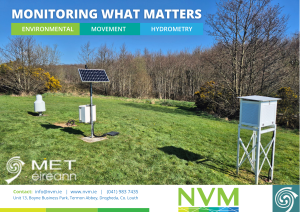
From a monitoring perspective, this matters. Climate change in Ireland is now best understood through long-term observation rather than episodic events. Temperature, rainfall, wind and soil moisture data increasingly show deviation from historic norms, with implications for flood risk, water availability and infrastructure resilience.
The value of 2025 lies in the strength of the dataset rather than novelty. Signals across climate, hydrology and ecosystem stress aligned. This consistency reduces uncertainty and increases confidence in trend analysis. The evidence base is now sufficiently robust to support forward planning and risk assessment, provided it is actively used.
Water quality data illustrates this clearly. EPA monitoring continues to show that over half of Ireland’s rivers, lakes and estuaries fall below satisfactory ecological status. Nutrient pressure remains the dominant factor. For monitoring bodies, this highlights the importance of integrated datasets that link climate conditions, land use and water outcomes rather than treating them as separate issues.
Similarly, biodiversity indicators and land condition data show slow recovery even where pressures have been reduced. At the same time, monitoring has improved understanding of the functional role of peatlands, wetlands and river systems in carbon storage and water regulation. These landscapes are increasingly recognised as critical natural assets, measurable in terms of both risk reduction and system resilience.
Ireland’s climate governance framework now relies heavily on monitored data. Carbon budgets, sectoral targets and adaptation planning depend on accurate, continuous observation. Projections published in 2025 confirmed that Ireland remains off track on emissions reduction, reinforcing the need for verified data to inform corrective action rather than retrospective reporting.
The defining shift in 2025 was the move from detection to dependence. Decision-making across climate policy, infrastructure planning and environmental regulation now depends on trusted monitoring systems. The question is no longer whether change is occurring, but how quickly it is happening and where impacts are accumulating.
As Ireland moves into 2026, the role of national climate monitoring is central. Consistent, high-quality data underpins credible planning, effective adaptation and public accountability. Without it, targets cannot be assessed and responses cannot be properly evaluated.
For NVM, the priority is clear: strengthen the evidence base that allows Ireland to move from observation to informed action.
If you need environmental monitoring guidance for your next project, contact the team at www.NVM.ie