Behind This Week's Heatwave Forecast: The Monitoring Network That Makes It Possible
Met Éireann has issued a nationwide weather advisory for a prolonged spell of very warm or hot weather, running from Wednesday into early next week. Temperatures are expected to widely exceed 25°C, potentially reaching the high 20s or low 30s from Friday, with high to very high UV levels and the possibility of tropical nights over the weekend.
For built-environment professionals, advisories like this carry practical weight: heat stress on site, drought pressure on water resources, elevated wildfire risk, and thermal effects on infrastructure and materials. But behind every forecast, advisory and heatwave declaration sits something less visible — a national network of monitoring stations producing the ground-truth data that makes the forecast possible.
How a heatwave is actually measured
In Ireland, a heatwave is defined as five or more consecutive days with maximum temperatures above 25°C at a given station. That definition only works if the station data is accurate, continuous and trusted. A drifting temperature sensor or a gap in transmission doesn't just affect one reading – it can compromise a dataset relied upon for national forecasting, climate records and public safety advisories.
Met Éireann's Climate Automated Monitoring Programme (CAMP) network – typically 60 to 80 stations distributed across the country — provides this ground-level data. Each station carries a suite of specialist instruments: air temperature and humidity sensors, soil sensors, grass temperature sensors, rain gauges and rainfall counters. Together they deliver continuous, site-specific climate data back to Met Éireann for analysis, modelling and forecasting.
NVM's role in the network
NVM holds the service, maintenance and supply contract for Met Éireann's CAMP stations nationwide. Our work covers routine and reactive maintenance, on-site calibration, sensor replacement and servicing, data logger and power system upkeep, data acquisition and management, and verification that live data is transmitting successfully to Met Éireann.
During a heatwave, this work matters more, not less. Sustained high temperatures are precisely the conditions under which sensor accuracy is scrutinised – these are the readings that determine whether heatwave thresholds are met, feed drought assessments, and inform advisories on heat stress and wildfire risk. Preventative maintenance, early fault detection and rapid response keep the network delivering when the data is under the most demand.
The wider picture: heat, drought and water resources
Prolonged warm, dry spells don't just register on thermometers. They draw down river flows and groundwater levels, concentrate pressure on abstraction points, and raise drought concerns – all of which Met Éireann has flagged as potential impacts of the current spell. Hydrometric and groundwater monitoring becomes central to how local authorities, Uisce Éireann and the EPA assess and manage water resources through the summer months.
NVM supports this side of the picture too, through hydrometric flow monitoring, groundwater instrumentation, and weather and solar monitoring for clients across the public and private sectors. Whether it's a national climate network or a single low-flow gauging point, the principle is the same: decisions are only as good as the data behind them.
If you have an environmental monitoring requirement – climate, hydrometric, groundwater or weather station infrastructure – get in touch with the NVM team.
📧 info@nvm.inview.ie | 📞 (041) 983 7435 | www.nvm.inview.ie
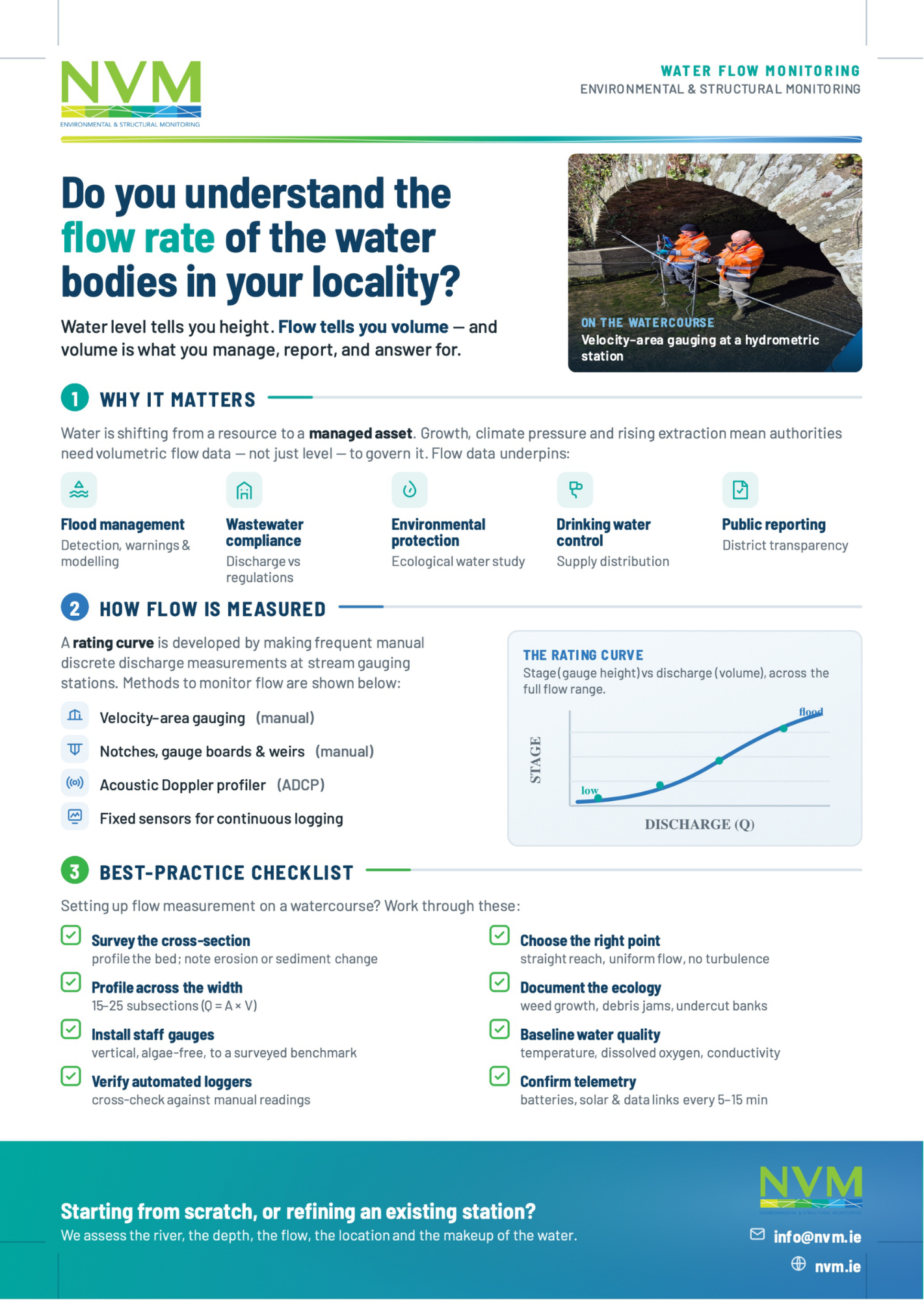
Why local authorities need flow data, not just water levels
Water is shifting from a resource to a managed asset. Population growth, climate pressure, and rising industrial and agricultural extraction are putting watercourses under strain – and local authorities are increasingly expected to govern, report on, and answer for the water within their districts.
Water level height is useful information on its own. But level only tells you how high the water sits. Flow tells you the volume moving through a channel – and volume is what underpins decisions on flood risk, wastewater compliance, and resource management.
What flow data supports
Volumetric flow data feeds directly into the work local authorities already do:
- Flood management: early detection and warnings, plus the hydrodynamic modelling used to run flood-control scenarios.
- Wastewater compliance: monitoring discharge at treatment plants to demonstrate environmental regulations are being met.
- Environmental protection: tracking water availability and movement to support ecological studies and water-body protections.
- Drinking water control: managing distribution and chemical dosing across supply systems.
- Public reporting: presenting water quality, flood risk, and resource management clearly to the municipal district.
How flow is actually measured
Here's the practical complication: most devices measure flow at a single point in time. Measuring continuous flow in a river usually isn't practical.
Instead, monitoring relies on the relationship between water level height (stage) and volumetric flow (discharge) at each hydrometric station. That relationship is called a rating curve, and building a reliable one takes many measurements across the full range – from low flow to flood flow – gathered over a calendar year. That timing matters: river beds and embankments change with heavy rainfall, and summer growth can alter the channel.
Measurement methods include velocity–area gauging, structures such as notches and weirs, Acoustic Doppler Current Profilers (ADCP), and fixed sensors for continuous logging in open channels or pipes.
Getting it right
A few points separate good flow data from misleading data:
- Choose a straight section of channel with uniform flow, clear of turbulence and backwater pooling.
- Survey the channel cross-section, and re-check it for erosion or sediment change.
- Profile across the width – dividing into enough subsections to compute area and average velocity accurately.
- Document vegetation, debris, and undercut banks that can distort readings.
- Pair flow logging with baseline water-quality indicators like temperature, dissolved oxygen, and conductivity.
- Cross-verify automated loggers against manual measurements, and confirm telemetry is transmitting on schedule.
Where to start
Whether you're setting up from scratch or refining an existing station, the starting questions are the same: the river, the depth, the flow, the location, and the makeup of the water. Get those right, and the instrumentation can be specified to match.
📧 info@nvm.inview.ie | nvm.inview.ie
The Role of Environmental Monitoring in Achieving Ireland's 2030 Climate Goals
While often criticised at home, Ireland's 2030 climate target is among the most ambitious in Europe.
Under the Climate Action and Low Carbon Development (Amendment) Act 2021, the State is legally bound to reduce greenhouse gas emissions by 51% by 2030, relative to 2018 levels, and to reach climate neutrality by 2050. The Climate Action Plan 2025 reaffirms that target and sets revised sectoral pathways across electricity, transport, the built environment, industry, agriculture and land use.
The gap between policy ambition and projected outcome is well documented. The EPA's most recent greenhouse gas projections, published in May 2025, indicate that, even with full implementation of currently planned measures, Ireland is on track for a reduction of up to 23% by 2030. The first carbon budget (2021–2025, 295 MtCO₂eq) is projected to be exceeded by 8 to 12 MtCO₂eq, and the second budget (2026–2030, 200 MtCO₂eq) by a significantly larger margin once carryover is included. Ireland's separate target of a 42% reduction under the EU Effort Sharing Regulation is also out of reach on the current trajectory.
These projections are derived from monitored data. Carbon budgets, sectoral emissions ceilings and adaptation planning are only as credible as the measurement infrastructure that underpins them. Without continuous, verified environmental data, neither progress nor underperformance can be properly assessed, and corrective policy cannot be evidence-based.
This is where environmental monitoring moves from a compliance activity to a strategic function. Meeting 2030 targets requires a substantial scaling of renewable electricity, including thousands of megawatts of additional onshore wind and solar capacity, alongside offshore wind and a continued role for hydropower. Each of these technologies depends on accurate environmental data – water levels and flow for hydro feasibility and operation, weather data for siting and yield, and ground conditions for foundation design and asset protection.
For hydropower and water-dependent infrastructure, hydrometric monitoring of river flows, levels and rainfall remains foundational. NVM Limited supplies and maintains OTT Hydromet hydrometric sensors and data loggers, including instrumentation deployed in support of Met Éireann's national observation network. The same categories of data feed flood forecasting, abstraction assessment and the analysis of climate-driven changes to Ireland's hydrological cycle.
For wind, solar and grid-scale developments, the construction and operational phases each carry distinct monitoring obligations. Vibration, noise and dust monitoring protect sensitive receptors during civil works and demonstrate compliance with planning conditions, EPA licence requirements and conditions imposed by An Coimisiún Pleanála. Geotechnical instrumentation – piezometers, inclinometers, settlement points and tilt sensors – provides early warning of ground movement on substations, turbine foundations, cable routes and battery storage compounds.
The same monitoring disciplines apply to the built environment sector, which has its own demanding 2030 reduction pathway. Retrofit programmes, district heating, transport infrastructure and accelerated residential delivery all rely on robust baseline environmental data and continuous measurement to satisfy environmental impact assessment requirements, manage construction risk and protect surrounding communities.
Ireland's 2030 commitments will not be met by policy alone. They will be met, or missed, on the basis of measurable change in real projects, across real sectors, over the next four years. The role of environmental monitoring is to make that change visible – to quantify emissions, to verify abatement, to evidence compliance and to support the build-out of the infrastructure that decarbonisation requires.
For NVM, the focus remains consistent with that direction. Reliable instrumentation, hire-ready monitoring solutions and field-tested expertise allow project teams, regulators and asset owners to base decisions on data that holds up to scrutiny.
If you need environmental monitoring guidance for your next project, contact the team at www.NVM.ie
On 24 February 2026, the Minister for Housing, Local Government and Heritage signed European Union (Water Policy) (Small Wastewater Discharge Register) Regulations 2026 (S.I. No. 65/2026) into effect, which gives effect to Article 11(3)(g) of the Water Framework Directive (2000/60/EC) and introduces a national register for a category of discharge that has, until now, sat outside both the Uisce Éireann discharge licensing regime and the section 4 authorisations carried over from the 1977 Act.
For local authorities, approved housing bodies, design teams and contractors working on residential delivery — and for the engineers advising them — the regulations close a regulatory gap that has been visible for some time. They also introduce a defined set of operating, sampling and ecological monitoring obligations that will need to be planned for at design stage, not retrofitted after handover.
What the Regulations cover
The Regulations apply to small wastewater discharges to surface water from wastewater works with a population equivalent (p.e.) of 150 or less, where two or more domestic dwellings are connected to a collection system and the discharge is associated with a housing development. They do not apply to discharges already authorised under the Waste Water Discharge (Authorisation) Regulations 2007 or previously authorised under section 4 of the Local Government (Water Pollution) Act 1977.
The Environmental Protection Agency is required to establish and maintain the Small Wastewater Discharge Register, to publish details of registered discharges electronically, and to provide register entries on request. Uisce Éireann is the duty-holder: it must request registration before commencing a discharge, and it commits an offence if it discharges without being on the Register, fails to inform the Agency, or provides false or misleading information.
The registration criteria
Under Regulation 5, the EPA — after consultation with the Minister — is required to publish registration criteria within two months of the making of the Regulations. These criteria must, among other matters, address:
- the minimum flow required in the receiving surface waterbody to assimilate a discharge,
- and the estimation methodology to be used;
- how the population equivalent associated with a housing development is to be estimated;
- the requirement to conduct and record an assessment of the feasibility of connecting to the public sewer;
- and confirmation that planning permission has been granted for the development to which the discharge relates.
Only proposed discharges that satisfy these criteria to the Agency's satisfaction will be entered on the Register, and a registration number is issued as proof of registration.
The General Binding Rules — and why they matter at design stage
The Schedule to the Regulations sets out twenty-one General Binding Rules. Several have direct, practical consequences for scheme design and for the instrumentation that supports day-to-day operation.
Capacity and load: The works must serve a p.e. of 150 or less, calculated using the methodology specified in the published registration criteria, and the volume of treated wastewater discharged must not exceed 22.5 cubic metres per day, calculated as a daily average. Rainwater, surface water and runoff from paved areas must not enter the works, and only domestic wastewater may be collected and treated — trade effluent and industrial wastewater are prohibited.
Treatment performance: Wastewater must receive at least secondary treatment prior to discharge, with the Schedule setting limits of 25 mg/l O₂ for cBOD, 125 mg/l O₂ for COD, and 35 mg/l for total suspended solids. There is to be no discharge of priority substances within the meaning of S.I. No. 272 of 2009, and the discharge of gross solids and litter is prohibited.
Connection to the public sewer: Where it becomes feasible to connect the housing development to the public sewer, the development must be connected and the discharge and elements of the works decommissioned to the Agency's satisfaction. The feasibility assessment is therefore not a one-off exercise at registration; it is a continuing obligation across the asset's life.
Effluent monitoring: Uisce Éireann must inspect and sample the treated effluent twice a year and analyse it against the secondary treatment parameters above. The discharge point must be easily accessible and have a dedicated sampling point — a design requirement that is much easier to deliver up front than to retrofit. Monitoring records must be retained for seven years.
Ambient ecological monitoring: A small stream risk score assessment, or other suitable ecological assessment, must be carried out at suitable upstream and downstream locations once every three years, by a suitably competent person using a recognised methodology. Results must be retained indefinitely and made available to the Agency on request.
Incidents, complaints and cessation: Incidents — defined in the Regulations as events that do not comply with a general binding rule — must be reported as soon as practicable, with corrective and preventative action taken. Complaints must be recorded and investigated. Material alteration or cessation of a discharge must be notified to the Agency, and on cessation the works must be decommissioned, rendered safe or removed to avoid environmental pollution.
Implications for residential delivery
Recent NVM commentary has tracked the policy backdrop to this instrument: the NDP Sectoral Plan for Water Services and Water Quality, the State of the Environment Report 2024, and the operational reality of accelerated residential delivery on serviced and serviceable land. S.I. 65/2026 sits squarely within that frame. It formalises the regulatory route for the small developments — typically rural, edge-of-settlement, or in advance of network extension — where Uisce Éireann is the operator of a standalone treatment works rather than connecting to an existing network.
Three practical consequences are worth flagging early
First, the planning-permission link in Regulation 5(2)(d) and 7(1)(c) means the discharge route now has a hard dependency on a granted permission. Where a development is being progressed in parallel with an Uisce Éireann connection assessment, sequencing matters.
Second, the receiving-water assimilation test embedded in the registration criteria — minimum flow in the receiving waterbody, with a defined estimation methodology — places a premium on credible, locally relevant hydrometric data. For very small streams, where assimilative capacity is a binding constraint, robust baseline characterisation may be the difference between a workable and an unworkable scheme.
Third, the Schedule's ambient monitoring requirement establishes a recurring three-yearly ecological assessment obligation for the operational life of the works. That is a sustained, multi-decade commitment for any scheme registered under these Regulations, with records retained indefinitely.
A measured step in a longer programme
S.I. 65/2026 does not change the licensing regime for larger Uisce Éireann discharges, and it does not affect domestic wastewater treatment systems serving single houses. What it does is bring a previously informal category of discharge into a defined register, with published criteria, a clear duty-holder, and a Schedule of binding operational and monitoring rules.
For built-environment professionals, the value of engaging with the detail now — at the design stage of schemes that may fall under the threshold — is straightforward: the registration criteria, the dedicated sampling point, the receiving-water assessment and the three-yearly ecological monitoring are all easier and cheaper to plan in than to bolt on later.
NVM Limited supports operators, consultants and delivery teams across the hydrometric, environmental and groundwater monitoring disciplines that this instrument will draw on. As the EPA's published registration criteria become available, we will return to the methodological detail — particularly on minimum-flow estimation and ambient ecological assessment — in a follow-up post.
The Environmental Protection Agency has awarded €6.5 million to 24 research projects under its 2025 research call.
University of Galway secured eight of the awards, with other successful institutions including University College Cork and Technological University Dublin. The funded themes include peatland monitoring, methane sources and sinks, national policy impacts on atmospheric climate targets, and the joint probability of multi-driver floods along Ireland’s coastline.
On the surface, this is a routine research announcement. In practice, it is a map of where the State is investing in environmental intelligence. For those operating in planning, development, infrastructure and finance, the signal matters.
Reading policy direction through research allocation
Public research funding rarely drifts far from regulatory intent. The concentration on peatlands, methane accounting, climate modelling and compound flood risk reflects an intensifying focus on carbon measurement, land use change, and climate adaptation within Ireland’s governance framework.
Peatland monitoring is not only a biodiversity issue. It is central to national carbon accounting and land use policy. As methodologies improve, expectations around land management, restoration, and offsetting claims are likely to tighten. Developers operating in or near peatland areas should anticipate greater evidential requirements and more granular environmental assessment.
Similarly, research on methane sources and sinks speaks directly to agricultural emissions, waste management and energy systems. Enhanced measurement capacity typically precedes stricter performance benchmarks. Where data improves, tolerance for uncertainty reduces. That has implications for permitting regimes, infrastructure planning and sectoral emissions ceilings.
The study of national policy impacts on atmospheric climate targets suggests increasing scrutiny of the gap between stated objectives and measurable outcomes. If modelling becomes more precise, it will be more difficult for sectoral plans or development strategies to rely on broad projections. Policy alignment with carbon budgets may become more explicitly enforced at project level.
Most directly relevant to the built environment is the research into multi-driver coastal flood probability. Ireland’s coastline faces compound risks driven by storm surge, sea-level rise, river discharge and rainfall events. Better joint probability modelling will influence flood maps, zoning decisions, insurance pricing and the viability of coastal and estuarine development. Where risk models become more sophisticated, planning authorities and An Bord Pleanála are likely to rely on them.
From research to compliance pressure
For the development and construction sector, improved environmental intelligence does not remain academic for long. It is typically translated into guidance, technical standards, and judicially reviewable criteria.
The co-funding of flood probability, flow statistics and climate modelling research by Met Éireann and the Office of Public Works indicates operational intent. These are not abstract studies. They are likely to inform flood risk management plans, development plan reviews and infrastructure design codes.
More refined flood modelling can alter site classification, trigger additional assessment requirements, or require redesigned mitigation measures. In coastal counties, this may affect land values, lending conditions and long-term asset strategy. Institutional investors and lenders will increasingly look to updated State-backed models when assessing exposure.
Enhanced climate modelling and emissions accounting will also intersect with ESG reporting obligations and sustainable finance frameworks. As datasets improve, the credibility of climate resilience claims and carbon reduction pathways will face closer examination. Developers and infrastructure operators will need to demonstrate alignment not only with planning permission but with evolving environmental baselines.
The 2026 research call is expected to launch later this year.
Construction vibration monitoring is a practical, evidence-led discipline focused on managing risk in live construction environments. Activities such as piling, demolition, ground improvement, and heavy plant operation inevitably generate vibration. Without structured monitoring, these vibrations can pose risks to nearby buildings, buried services, sensitive infrastructure, and the people who live and work close to construction sites: https://nvm.inview.ie/services/vibration-monitoring-2/
In practice, vibration monitoring is about anticipation, control, and accountability. The process typically begins before works commence, with baseline vibration surveys undertaken to establish existing conditions at identified sensitive locations. For NVM, this step is fundamental. Baseline data provides a factual reference point, allowing project teams to differentiate between pre-existing conditions and construction-related effects, and to engage with stakeholders from a position of transparency and technical credibility.
Once construction is underway, vibration monitoring equipment is installed at agreed monitoring points, selected based on site layout, construction methods, and receptor sensitivity. These instruments continuously measure vibration levels, commonly focusing on peak particle velocity and frequency, which are internationally recognised indicators of potential impact on structures. Thresholds are set in line with project requirements, regulatory guidance, and the vulnerability of surrounding assets.
Real-time monitoring is central to how vibration monitoring works in practice on active sites. Continuous data collection enables immediate visibility of vibration trends, allowing contractors and site managers to respond proactively. Where trigger levels are approached or exceeded, construction methods can be adjusted, sequencing refined, or works temporarily paused. This approach supports compliance while minimising disruption and avoiding reactive problem-solving after issues have arisen.
From NVM’s perspective, vibration monitoring is not solely a technical exercise. Human perception of vibration is highly variable, and even low-level vibration can generate concern, complaints, or loss of trust if not managed properly. A well-designed monitoring strategy therefore considers not just structural risk, but also the experience of neighbouring occupants. Clear communication, supported by objective data, is critical in maintaining confidence throughout the construction phase.
Reporting is a key practical output. Monitoring data must be translated into clear, defensible reports that can be understood by clients, regulators, designers, and affected stakeholders. NVM places emphasis on reporting that supports decision-making, demonstrates compliance with planning and environmental conditions, and provides a robust audit trail should queries or disputes arise during or after construction.
In day-to-day construction practice, vibration monitoring functions as part of a wider risk management and quality assurance framework. It supports safer working methods, protects adjacent assets, and reduces the likelihood of programme delays, claims, or reputational damage. When integrated early and managed correctly, it becomes an enabler of efficient construction rather than a constraint.
NVM’s approach to construction vibration monitoring is grounded in practical site experience. Services are designed to align with real construction workflows, from baseline surveys and monitoring plan development through to real-time data delivery and clear reporting. The focus is on proportionate, reliable monitoring that supports project delivery while safeguarding surrounding buildings, infrastructure, and communities.
For location-specific environmental monitoring advice for your next development project, contact info@nvm.inview.ie
Ireland's environmental record in 2025 was not defined by a single dramatic climate event. Instead, it was shaped by a steady accumulation of pressure: higher average temperatures, longer dry spells, intense rainfall, and repeated flooding in places already exposed. These conditions did not represent anomalies. They reflected a changing baseline, as reported by Michelle McKeown in the Irish Examiner: (https://www.irishexaminer.com/lifestyle/outdoors/arid-41766998.html)
From a monitoring perspective, this matters. Climate change in Ireland is now best understood through long-term observation rather than episodic events. Temperature, rainfall, wind and soil moisture data increasingly show deviation from historic norms, with implications for flood risk, water availability and infrastructure resilience.
The value of 2025 lies in the strength of the dataset rather than novelty. Signals across climate, hydrology and ecosystem stress aligned. This consistency reduces uncertainty and increases confidence in trend analysis. The evidence base is now sufficiently robust to support forward planning and risk assessment, provided it is actively used.
Water quality data illustrates this clearly. EPA monitoring continues to show that over half of Ireland’s rivers, lakes and estuaries fall below satisfactory ecological status. Nutrient pressure remains the dominant factor. For monitoring bodies, this highlights the importance of integrated datasets that link climate conditions, land use and water outcomes rather than treating them as separate issues.
Similarly, biodiversity indicators and land condition data show slow recovery even where pressures have been reduced. At the same time, monitoring has improved understanding of the functional role of peatlands, wetlands and river systems in carbon storage and water regulation. These landscapes are increasingly recognised as critical natural assets, measurable in terms of both risk reduction and system resilience.
Ireland’s climate governance framework now relies heavily on monitored data. Carbon budgets, sectoral targets and adaptation planning depend on accurate, continuous observation. Projections published in 2025 confirmed that Ireland remains off track on emissions reduction, reinforcing the need for verified data to inform corrective action rather than retrospective reporting.
The defining shift in 2025 was the move from detection to dependence. Decision-making across climate policy, infrastructure planning and environmental regulation now depends on trusted monitoring systems. The question is no longer whether change is occurring, but how quickly it is happening and where impacts are accumulating.
As Ireland moves into 2026, the role of national climate monitoring is central. Consistent, high-quality data underpins credible planning, effective adaptation and public accountability. Without it, targets cannot be assessed and responses cannot be properly evaluated.
For NVM, the priority is clear: strengthen the evidence base that allows Ireland to move from observation to informed action.
If you need environmental monitoring guidance for your next project, contact the team at www.NVM.ie
Accurate, localised environmental data is the foundation for effective decision-making across agriculture, infrastructure, climate science and public safety. For Ireland’s national meteorological service, Met Éireann (https://www.met.ie/), the reliability of this data depends not only on advanced instrumentation, but on consistent, expert management of monitoring infrastructure on the ground.
The NVM Limited team works in partnership with Met Éireann to support the operation, maintenance and integrity of its Climate Automated Monitoring Programme (CAMP) stations nationwide.
The CAMP Network
Met Éireann operates a distributed network of CAMP stations located across Ireland, typically numbering between 60 and 80 sites. These stations collect high-resolution, localised climate data using a range of specialist sensors, including:
- Soil sensors
- Air temperature and humidity sensors
- Rain gauges and rainfall counters
- Grass temperature sensors
Together, these instruments provide continuous, site-specific environmental data that is transmitted back to Met Éireann for analysis, modelling and forecasting. The quality and continuity of this data is critical. Any interruption, sensor drift or equipment failure can compromise datasets that are relied upon nationally.
NVM’s Role
NVM holds the service, maintenance and supply contract for Met Éireann’s CAMP stations. Our role is to ensure that each monitoring site operates reliably, accurately and without interruption.
This is a full-service contract encompassing:
- Routine and reactive maintenance of CAMP stations
- On-site calibration of environmental instruments
- Replacement and servicing of sensors and components as required
- Maintenance of data loggers, cabling and power systems
- Data acquisition, download and management
- Verification that live data is being successfully transmitted to Met Éireann
In addition to technical performance, NVM is responsible for general site upkeep – ensuring stations are clean, secure and fit for purpose in often exposed and challenging environments.
Precision, Reliability and Continuity
Environmental monitoring infrastructure must perform consistently over long periods, often in harsh conditions. NVM’s work focuses on maintaining data integrity through preventative maintenance, early fault detection and rapid response when issues arise. By recalibrating instruments on site and replacing equipment only when required, we support both accuracy and value for money, while minimising downtime and disruption to national datasets.
This collaboration reflects NVM’s wider expertise in environmental monitoring, instrumentation and data systems over the past two decades. Our approach is practical, detail-driven and grounded in a clear understanding of how environmental data is used by regulators, scientists and public bodies. Working with Met Éireann, NVM helps ensure that Ireland’s climate monitoring network continues to deliver dependable, high-quality data – supporting informed decisions today and long-term climate insight for the future.
www.nvm.inview.ie
Best practice for protecting the environment and ensuring strong community engagement
– Noel Carr, Director with NVM Limited
Delivering housing at speed is now a national priority. Local authorities and approved housing bodies are being challenged to bring forward serviced land, mobilise delivery teams, and accelerate construction – whether through traditional build, timber frame, off-site or other modern methods of construction (MMC). Yet speed cannot come at the expense of environmental stewardship or community relations.
This is where environmental monitoring plays a critical – but often overlooked – role in enabling faster, compliant, and community-supported residential development.
The NVM team brings a level of technical strength that gives clients real confidence. Our work shows that environmental monitoring isn’t an extra layer of red tape – it’s a practical tool that supports planning, keeps construction running smoothly, and helps maintain strong communication with the local community throughout the project.
Starting with Site Readiness: Understanding the Receptors
When a local authority begins preparing a greenfield or brownfield site for rapid housing delivery, the first question is not about the build system – it is about the environment and the people around it.
The starting point is identifying the receptors – the natural and human environments that could be affected during construction. These may include nearby schools, existing housing, commercial premises, or environmentally sensitive areas. From plant movement to ground breakout, from compaction to elevated noise or dust, each element of site activity has the potential to impact these receptors.
This receptor-focused approach aligns with best practice under EU environmental directives and Irish planning policy. It ensures that potential impacts are identified and understood early, before designs are finalised or contractors mobilised.
Building the Monitoring Framework
Once receptors are identified, the next step is to design and install a comprehensive environmental monitoring plan. Based on our experience this includes:
- A structured baseline survey for noise, dust, and vibration
- Installation of live monitoring equipment at critical receptor locations
- Continuous monitoring throughout construction to ensure compliance
- Clear reporting lines between the monitoring company, the contractor, and the local authority
This transparent information flow is central:
“It’s about having a clear path, a clear channel for the information to come through, so that there’s nothing hidden.” Noel Carr, Director of NVM
This is the basis of best practice and it is essential for maintaining community trust on local projects.
Why Monitoring Matters for Community Engagement
Ireland has limited experience in the delivery of rapid-delivery projects, including housing, and every site carries community sensitivities. Concerns about dust, noise, vibration, traffic movements, or property impacts can undermine support for new housing if not managed properly.
Real-time monitoring offers reassurance. It means:
- Local residents can trust that environmental impacts are measured objectively
- The local authority can demonstrate proactive oversight
- Issues can be addressed immediately rather than reactively
- Communication is based on data, not speculation
Responding to Ireland’s housing emergency requires an approach that is not business-as-usual. The usual procurement and planning may need to be re-imagined or re-sequenced, with compliance being achieved retrospectively. Community trust cannot be built retrospectively; it must be earned throughout the duration of the build.
Best-Practice Framework for Construction Environmental Monitoring
NVM’s recommended approach can be summarised as a practical, seven-point best-practice model.
Key objectives include:
- Reviewing all off-site sensitive locations
- Establishing reliable baseline conditions
- Continuous live monitoring for the duration of works
- Implementing on-site mitigation measures
- Protecting the structural integrity of third-party assets
- Ensuring construction noise and vibration remain within predictive limits
- Providing clear, transparent reporting channels
Contrary to outdated perceptions, environmental monitoring does not slow down delivery. It accelerates it by:
- Preventing stoppages due to complaints or exceedances
- Supporting planning applications with robust data
- Allowing modular or MMC delivery teams to operate efficiently
- Reducing legal and operational risk for local authorities
- Ensuring compliance with environmental and building regulations
In practice, monitoring de-risks the project, protects the environment, and strengthens community support, all of which enable faster housing delivery.
The Department of Housing, Local Government and Heritage has now published its National Development Plan (NDP) Sectoral Plan for Water Services and Water Quality, setting out how record investment of €12.2 billion will be deployed across the water sector over the coming years. More than 95% of this – €11.7bn – is allocated to Uisce Éireann, making it the largest capital programme in the history of Irish water services.
*Download the plan in full at: https://assets.gov.ie/static/documents/799db031/Investment_Plan_Water_Services_and_Water_Quality.pdf
Critically, this is not a standalone utility upgrade. Water infrastructure is now a direct determinant of the State’s ability to meet housing targets. Without increased treatment capacity, expanded networks and improved environmental compliance, planned housing delivery simply cannot proceed. Government finally acknowledges this interdependency – and the numbers reflect it.
Water Infrastructure as a Hard Constraint on Housing Delivery
The new sectoral plan makes explicit what industry has long understood: housing output is capped not by land or zoning, but by the availability, reliability and regulatory compliance of water and wastewater systems.
Key pressure points include:
- Capacity constraints across cities and regional towns, many of which cannot accommodate additional units without major upgrades to water and wastewater treatment plants.
- Regulatory compliance obligations, particularly EPA Remedial Action List drinking water plants and Priority Action List wastewater plants, which must be addressed before further growth can be sanctioned.
- A decade-long ramp-up in demand that existing networks were never designed to support.
To address these issues, Uisce Éireann’s Strategic Funding Plan – now backed by multi-year certainty under the NDP – targets over 340 new or upgraded treatment plants, approximately 900km of network rehabilitation, and 360km of network extensions nationwide.
For the housing sector, the most consequential element is the Growth Investment Programme, a €1.7bn package focused on delivering water services capacity in locations aligned with the National Planning Framework, Regional Spatial & Economic Strategies, and local development plans. At least 71 settlements have been identified where existing treatment capacity can support accelerated development in the short term.
This is the first time such cross-referencing between housing policy and water capital planning has been formalised at national level.
Major Projects: Critical Path for Dublin and the Regions
Two major infrastructure schemes dominate the plan – both essential for Dublin’s housing and economic trajectory:
1. Water Supply Project – Eastern and Midlands Region (WSP-EMR)
A national-scale project capable of serving up to 50% of the population, supplying treated water from the Parteen Basin to Dublin with offtakes across Tipperary, Offaly and Westmeath. This will fundamentally reshape long-term water security for the metropolitan area. Planning is expected to be submitted in 2025, with delivery forecast for 2032.
2. Greater Dublin Drainage (GDD)
A new 500,000 PE wastewater treatment plant at Clonshaugh, a 14km orbital sewer, and an 11km marine outfall. Without GDD, further housing in north Dublin and surrounding counties will remain severely constrained. Planning approval was granted in 2025, though Judicial Review proceedings are ongoing. Completion is targeted for 2032.
Beyond Dublin, significant upgrades in Limerick, Waterford, and the Ballymore Eustace–Saggart resilience project each exceed €200m and are designed to address population growth and regional development priorities.
Rural Water and Water Quality: Small Budgets with Big Impact
Although €230m for rural water represents a small share of total investment, its strategic importance is high. Group water schemes service 6% of households and are often located in growth towns with acute supply or quality issues.
Water quality programmes — funded at €306m — target agriculture, urban runoff and river barriers, supporting Ireland’s Water Framework Directive obligations. These measures will not directly release housing units, but they reduce environmental risk, accelerate planning decisions, and avoid ecological bottlenecks that can delay major schemes.
What This Means for Housing, Planning and the Construction Sector
1. A move from reactive to planned capacity delivery
The State is finally shifting from incremental upgrades to long-term, generational investment planning. This gives developers, planners and local authorities a clearer line of sight on when capacity will be available.
2. Expect more precision in housing approvals
Local authorities will increasingly condition development on confirmed water and wastewater capacity. Locations identified in the Growth Investment Programme may see accelerated approvals.
3. Continued pressure on statutory timelines
Major projects are planned to 2031–2032. Delays in planning or licensing could have downstream effects on projected housing delivery.
4. Environmental compliance becomes non-negotiable
EPA oversight is embedded in investment prioritisation. Plants on the Remedial Action and Priority Action lists will move up the queue, but until works are complete, development in some areas will remain constrained.
5. Infrastructure is now the defining variable in housing policy
Transport, energy and water are now explicitly tied to new housing targets. This integrated approach is overdue – but transformative.
Bluntly, Ireland cannot meet its housing targets without modern, resilient, and compliant water services – and our team at NVM will continue to support this objective through the provision of advanced environmental, hydrometric and geotechnical monitoring solutions, real-time data acquisition and analysis, and instrumentation programmes that ensure infrastructure delivery is underpinned by rigorous measurement and insight.